As a Financial Coach, I’m regularly looking at what people spend money on. One thing on my radar is a client’s taxable income and whether or not they have private health cover and if they’re getting close to the MLS (Medicare Levy Surcharge).
Sometimes, choosing not to have a Private Health Cover can be more costly than actually having a policy.
So, what is the Medicare Levy Surcharge and will you be paying it in 2026/2027?
What’s the Medicare Levy Surcharge?
The Medicare Levy Surcharge (MLS) is an extra tax on a taxpayer, who earns above a set income threshold and does not have Private Health insurance with hospital coverage. The government levy is to help lighten the load of the public Medicare System.
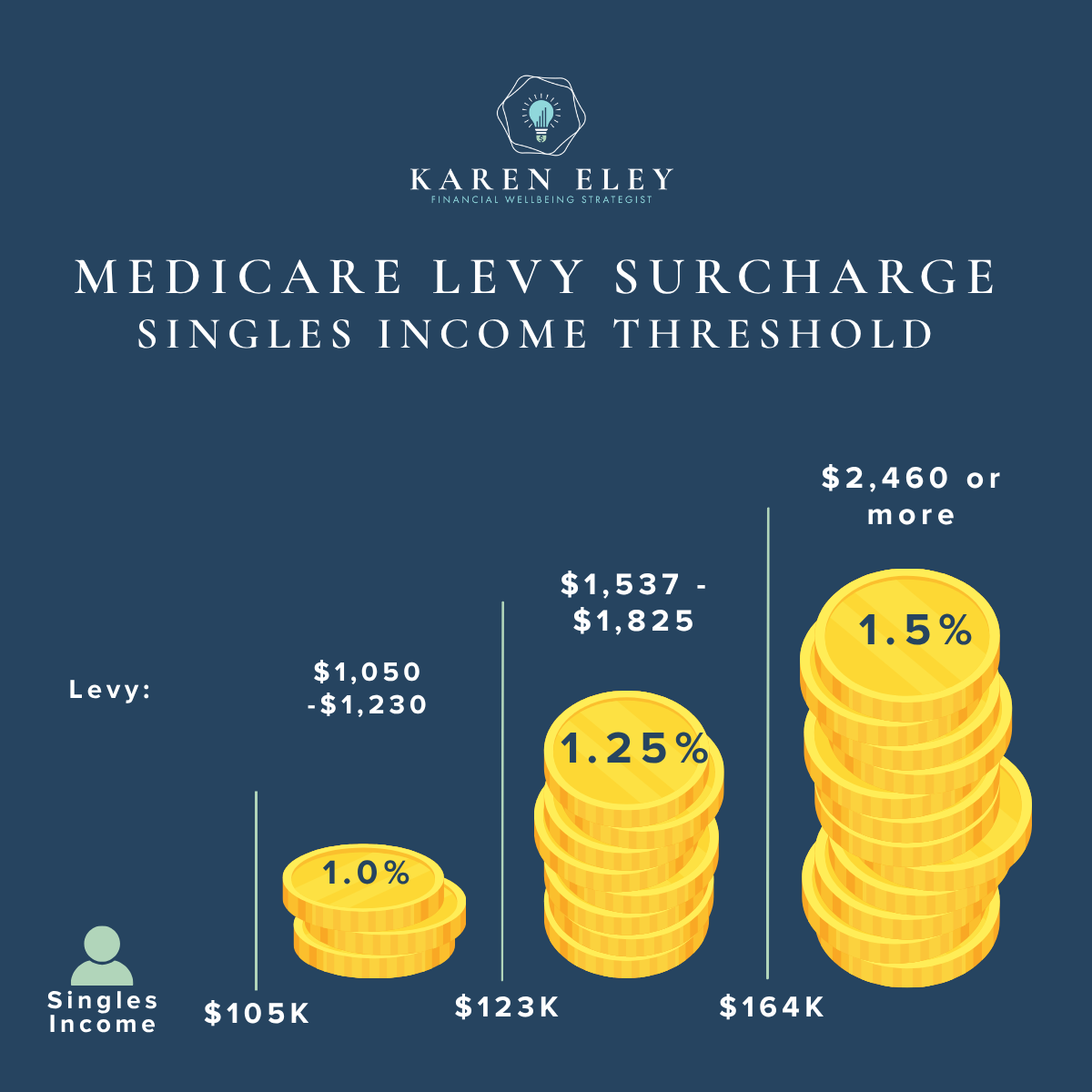
The surcharge is calculated at a rate of 1% to 1.5% of income above the threshold for the Medicare Levy Surcharge purpose, and is in addition to the 2% Medicare levy, which is paid by most Australian taxpayers.
Below are the thresholds for the 2026-27 financial year.
.png)
Who pays the Medicare Medicare Levy Surcharge?
The MLS applies to the following people, who earn above the threshold but do not hold Private Health cover:
- Singles with an annual taxable income exceeding $105,000.
- Couples and families with a combined taxable income of $210,000 or more (this threshold increases by $1,500 for every dependent child).
To make an informed choice about Private Health cover, let me illustrate using a practical example.
Sarah is 40, single, and has recently progressed in her career. She now earns $160,000 per year.
She doesn’t currently have private hospital cover, but after speaking with a health insurer, she finds a basic hospital policy that would cost her around $160 per month. So the question is:
Is she better off paying for private health cover, or simply paying the Medicare Levy Surcharge at tax time?
For the 2026–27 financial year, a single person with income for MLS purposes between $123,001 and $164,000 falls into the 1.25% Medicare Levy Surcharge tier if they don’t hold eligible private hospital cover.
Sarah’s income is $160,000, so if she doesn’t have eligible private hospital cover, her estimated Medicare Levy Surcharge would be:
$160,000 x 1.25% = $2,000
Now compare that with the cost of the private hospital cover:
$160 per month x 12 months = $1,920 per year
In this example, Sarah would pay approximately $2,000 in Medicare Levy Surcharge if she had no eligible hospital cover, compared with $1,920 per year for the private hospital policy.
On the numbers alone, Sarah may be around $80 better off by taking out the hospital cover rather than paying the surcharge.
But this is where the decision becomes more than just a tax calculation.
Sarah also needs to consider:
- whether the policy excess is no more than $750 for singles
- if this policy also has access to extra valuable benefits
- whether the $160 p/mth premium includes a Lifetime Health Cover loading
- whether she actually wants access to the private hospital system
- does the policy provides meaningful cover, or is simply being purchased to avoid the surcharge
Because Sarah is 40, if she has never held private hospital cover, she may also have a Lifetime Health Cover loading applied to her hospital premium. This loading is generally 2% for every year she is aged over 30 when she first takes out hospital cover, up to a maximum of 70%. That loading usually remains for 10 years of continuous hospital cover.
So while the pure maths suggests the private hospital policy may be slightly cheaper than paying the surcharge, Sarah still needs to look at the quality of the cover, her health needs, her cashflow, and whether the premium quoted already includes any Lifetime Health Cover loading; or if it’s better to start paying it now rather than waiting to when her income increases further or she wants cover in her 50’s..
What's a Lifetime Health Cover (LHC) Loading?
The Lifetime Health Cover (LHC) Loading is designed to encourage young people to get health insurance earlier to help ease the burden on the public health system.
This applies to anyone who doesn’t have Private Health Insurance with at least hospital cover included.
It starts on July 1, following your 31st birthday, on which the LHC Loading applies, 2% increase in premiums per year for every year. It caps out after 35 years at the maximum of 70% annual premiums, and it applies up to the age of 65 years old or older.
The LHC premium increases overtime as you get older, so if you are considering getting a Private Health Insurance, it’s important to consider how it may affect the future cost and choose the policy that best suits your preference and healthcare needs.
Just to keep in mind that the longer you wait after the age of 31, the higher the premium you pay through LHC loading.
You can use the Lifetime Health Cover Calculator to estimate the amount of loading you’d pay by deferring cover.
The key takeaway?
I encourage clients who are approaching or exceeding the Medicare Levy Surcharge thresholds to review their position before the end of the financial year or at the very start of a new one.
Sometimes people avoid private health cover because they see it as “another bill”. But if they’re going to pay a similar amount — or more — in extra tax anyway, it may be worth considering whether a suitable hospital (or extra benefits) policy gives them value in other ways.
That doesn’t mean private health cover is automatically the right choice. The cheapest policy isn’t always the best policy, and extras-only cover won’t help you avoid the Medicare Levy Surcharge. It does mean the decision should be made consciously, with the numbers in front of you so you can make an informed choice with your money.
Once your income increases, private health cover may no longer be just a health decision. It can also become a tax and cashflow decision.
Warmest,


